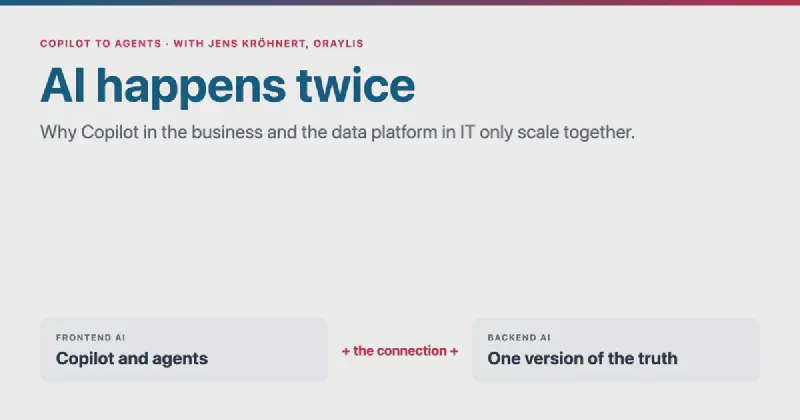
AI Happens Twice -- Copilot, Your Data Platform and the Bridge
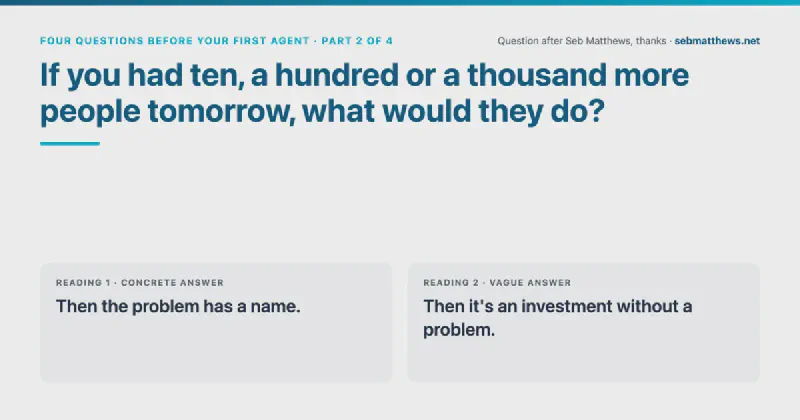
If You Had a Thousand More People Tomorrow, What Would They Do?
This post is also available in German: Wenn du morgen tausend Leute mehr hättest, was würden sie tun?
The masterclass ran on a Tuesday, 22 September, so I put it to the audience like this. Imagine that on 1 October, depending on the size of your team, your department or your company, ten, a hundred, a thousand or ten thousand extra people are standing at the door. They’re ready to work and they’re only waiting for you to tell them what to do. What do you tell them?
It’s the second of the four questions I opened our Solvion masterclass with, and I didn’t invent it. It comes from Seb Matthews and his piece “The AI Problem Is Not the AI”, and I’ve translated it for our sessions because it does something I find very hard to do any other way. It takes AI out of the room.
The question we get asked instead
The question we actually get asked most often goes the other way round, and I understand why. People we work with, people I like working with, say “tell us what others are doing, you see so many companies, which agents are they building?” We do know, and to be fair the answers are surprisingly similar, because at the meta level the challenges in companies are surprisingly similar too. But if I answer that question with a demo, it feels a bit as if we’re treating AI and Copilot as a technology looking for a problem. We have something that can do X or Y, and now let’s see where we can use it. That’s why our standard answer to “what are other companies doing with Copilot right now?” has become a question of its own. They’re solving their problems. Do you want to solve theirs, or yours?
Everyone in IT knows where that leads. If all you have is a hammer, everything looks like a nail, until somebody walks round the corner with a screw. The other version of the question I hear a lot is whether to go deep with one department that’s raising its hand and bringing energy, or to take many people one step further in AI literacy. Both are fair, but neither can be answered from the technology side.
Two kinds of answers
The thousand-people question has two possible outcomes. If someone can answer it concretely, if they can say where extra people would make a difference right away, they know the gap, the bottleneck and the yardstick. The problem has a name, and the conversation about AI that follows is productive, because now we look at that area and ask what AI can actually solve there.
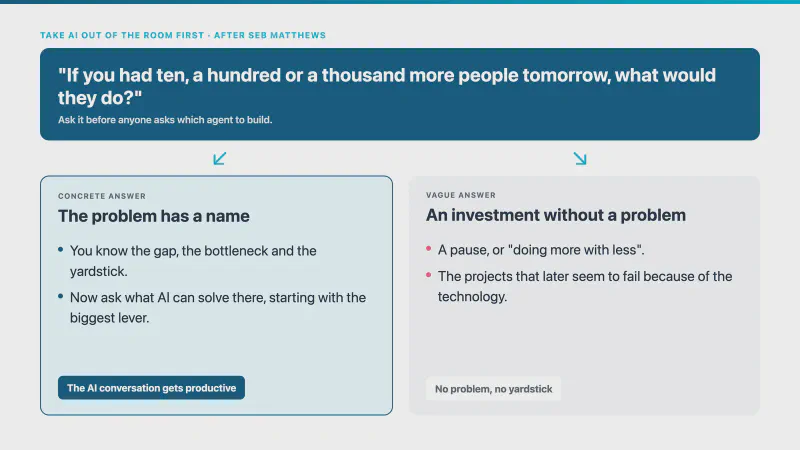
If the answer is vague, a pause or a sentence like “doing more with less”, the direction is clear but the goal isn’t. That’s an investment without a problem, and those are exactly the projects that later seem to fail because of the technology. In my experience something usually does come, though. Nearly every organisation has at least one place where they’d immediately send help if they had it.
Thinking about it a bit more strategically, this is a bottleneck strategy. Where is the biggest lever right now? You might find two or three, and that’s fine, you can split them up. The point is to look for where it really hurts.
Goodbye to the cappuccino use case
A customer gave me the best name for what this question filters out. They called it the cappuccino use case. It’s the agent that saves about as much time as it takes to drink a coffee, and you can’t sell that to a CFO, who’ll quite reasonably ask what three minutes a week is supposed to mean and point out that people will just do something else with them. Those use cases aren’t wrong, they’re just not where the impact is, and the thousand-people question pushes them out of the way almost by itself.
Where the other two decisions come in
Seb’s original argument goes further than the one question. He names three decisions that AI projects hinge on: which problem gets solved, what happens when the AI contradicts what the team believes, and who is accountable when it’s wrong. The thousand-people question tests the first one. The third is the last question of this series, who carries a solution once it carries weight. The middle one, what you do when the machine disagrees with your people, is the one I find hardest, and it isn’t one this series can answer for you.
Before that, though, the next part is about something more technical. Once you know the problem, the question is what an agent needs to know to solve it, and whose knowledge that actually is.
Enjoyed this post? Let's continue on LinkedIn.
Follow on LinkedIn