AI Happens Twice -- Copilot, Your Data Platform and the Bridge
Who Needs to Gain Which Competence, and Why?
This post is also available in German: Wer braucht warum welchen Kompetenzgewinn?
My two kids have been learning to ride a bike lately, and I’ve been watching them struggle with it, fall off, get back on and slowly get it. I’m no expert in teaching children anything, I’m just trying my best with my two. But I’m completely sure of one thing. It wouldn’t help at all if I showed them three 45-minute webinars on how to ride a bike, told them to go for it and offered an expert call in two weeks for their questions. Nobody learns to swim that way, or to drive, or to play the recorder. You have to do it, fall over, understand it, get up and keep going.
I used that picture to open our masterclass “Making AI agents tangible” at Solvion in September, the third one this year that Stephan Bisser, Christina Lierzer, Armin Einfalt and I ran together. Before Armin talked about what an agent needs before it’s built, Stephan built one live and Christina made sure somebody would actually use it, I framed the session with four questions. They’re the questions we ask ourselves before any AI or agent project, and I told the audience they’re welcome to take them and use them internally. This series is my attempt to give each of them a bit more room than the ten minutes I had.
The question reads two ways on purpose
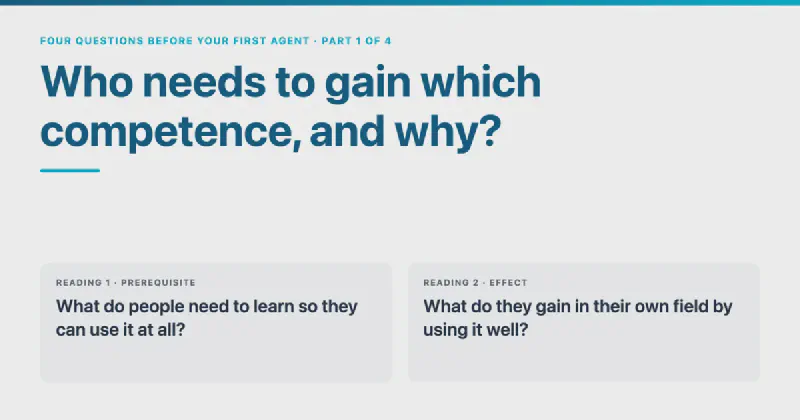
The first question is “who needs to gain which competence, and why?”, and like all four it’s deliberately ambiguous. In German we call it “Kompetenzgewinn”, the competence someone gains, and I’m avoiding the word skills on purpose, because in AI that already means something else. It means two things at the same time.
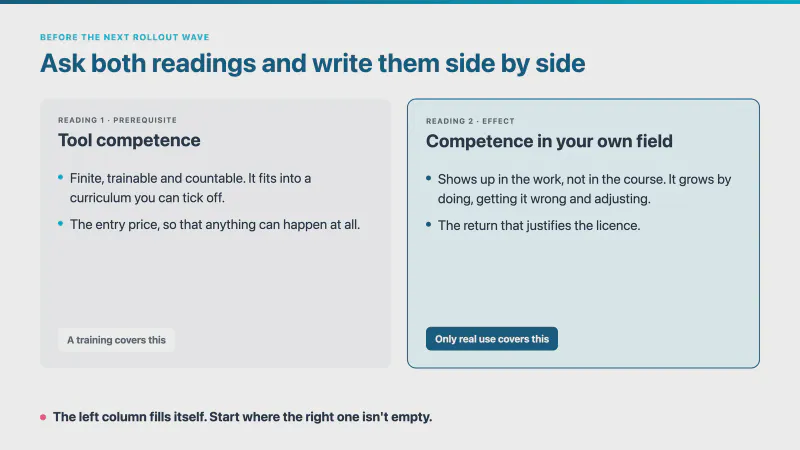
The first reading is the obvious one. What do people need to learn so they can use the new tool at all? There’s a new system, so you need to know how to work with it, how to prompt Copilot, where agents live, what you can trust and what you should check. That’s tool competence, and it’s finite, trainable and countable. You can put it in a curriculum and tick it off. It’s the entry price, the thing that has to happen before anything else can.
The second reading zooms out. What does someone gain in their own field by using the tool in a way that actually makes sense for their work? That’s not about handling Copilot smoothly, it’s about what changes in the job of a buyer, a project manager or a consultant once the tool is part of how they work. That gain is the return that justifies the cost, and it’s what any serious success model would call value.
If you only answer the first reading, you train people and call it impact.
Why the bike picture matters for Copilot rollouts
We see the same pattern up and down the country. Big slides about revolution, transformation and the new world of work, followed by three sessions of 45 minutes, and then the expectation that jobs look completely different and everything works. It doesn’t, of course. Tool training is necessary, but it covers the first reading only, and the second one doesn’t come from a training at all. It comes from people using the tool on their real work, getting it wrong, adjusting and slowly finding out where it changes something for them.
That has a consequence for licences, and it’s the part colleagues with a Microsoft email address in the audience tend to enjoy least. If the return comes from people using AI meaningfully in their field, then it matters a lot who gets a licence first, and the watering-can approach of handing out a few thousand licences evenly doesn’t produce that return on its own. I’d rather start with the roles and groups where the second reading has an answer, where we can say up front what a person in that role would do differently and what that would be worth. A licence for someone who never gets past the first reading is training budget with a monthly fee.
The question to ask before the next rollout wave
The way I use this question in practice is simple. Before a licence wave, a training plan or a new agent, ask both readings out loud and write down the answers next to each other. The left column is usually easy to fill, because it’s the curriculum. The right column is where the conversation gets interesting, because “people will be more productive” isn’t an answer, and “our project managers will stop writing status reports by hand and spend that time with the customer” is one you can actually check in three months.
If the right column stays empty, that’s not a reason to stop. It’s a reason to find the people for whom it isn’t empty and start there.
The next question looks at the same problem from the other side, not who needs to gain which competence, but which problem is worth solving in the first place.
Enjoyed this post? Let's continue on LinkedIn.
Follow on LinkedIn