Cogito, Ergo Build
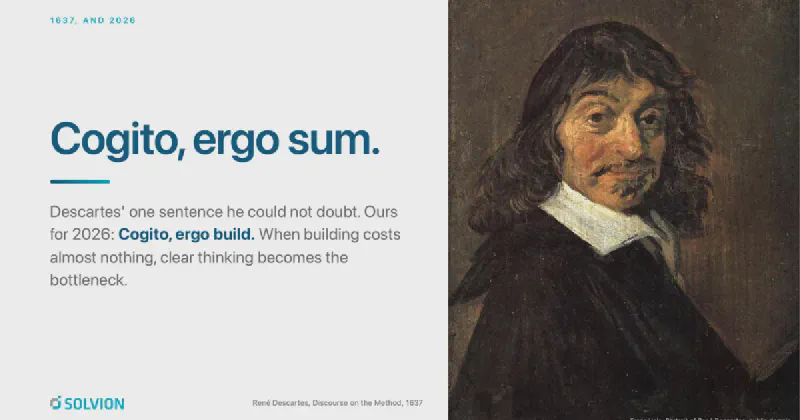
On Saturday at CollabDays Belgium we had a slide with René Descartes on it, the portrait by Frans Hals, and next to him the one sentence he decided he couldn’t doubt. Strictly speaking he first wrote it in French, “je pense, donc je suis”, in the Discourse on the Method in 1637, and the Latin “cogito, ergo sum” only turned up seven years later in his Principles of Philosophy. Our version for 2026 was “cogito, ergo build”, with the line underneath that when building costs almost nothing, clear thinking becomes the bottleneck. The thought itself has been with me for months as “if I can think it, I can build it”, and it only really got its charm once I thought it a size bigger and connected it to cogito, ergo sum.
Building got cheap enough to happen over lunch
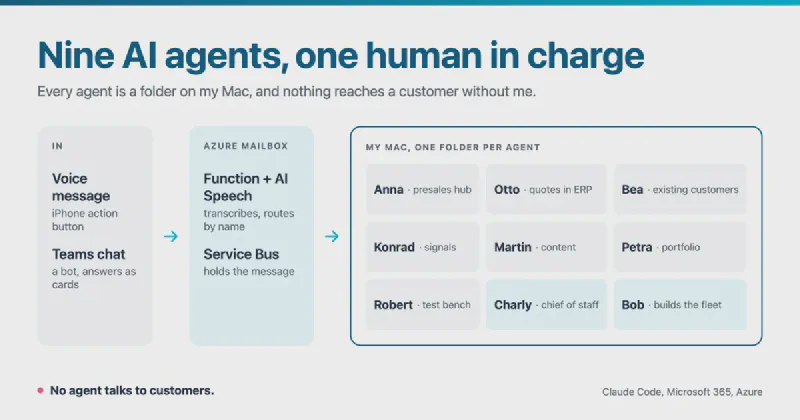
The cheap part is easy to show. Not long ago I watched our sales team work through a Microsoft List, clicking here and clicking there to get the numbers they needed, and I went to lunch and talked to Bob, the builder agent in my fleet. Two hours later they had a dashboard web part in SharePoint that did what all the clicking was meant to do. On Saturday I did the same thing on stage, asked the front row for a favourite colour, said a few sentences into my phone and Bob built a speaker memory game as an SPFx web part in blue and deployed it while Stephan and I kept talking. The voice pipeline behind that costs a few cents for Service Bus and an Azure Function and around four euros a month for transcription.
On the flight to the MVP Summit earlier this year I sat next to someone who works at Meta, where they build almost their entire tool chain themselves, and I asked him when he had last looked at code. He thought about it for a while and then admitted he simply couldn’t remember. It just works, it just runs. That’s the world we’re in now, and even I’m not sure it’s always a good idea. I suspect it depends a lot on what you’re building, because the 27th content aggregation web part in SPFx is not the same thing as the control software of a nuclear power plant. You have to know what you’re dealing with before you decide how much code nobody will ever read again, which is plain old risk analysis, and it doesn’t go away just because building got cheap. For most of what I build, though, coding is done, as I said on stage, and I meant it more literally than people probably took it. If you can think it, you can build it.
The only question left is whether you can think it
That second half of the sentence is where it gets hard. When the building is free, everything that used to hide behind the effort of building moves to the front, and that’s mostly thinking. What problem am I actually solving, what does done look like, and what does the agent need to know so it doesn’t guess? Stephan and I arrived in Belgium the day before with literally zero slides, and that’s true in the sense that there wasn’t a single bit or byte of a deck anywhere. What we did have were weeks of working through the topics, the way we always do before a talk, with hours of reading up and trying things out. That’s the groundwork that lets us be ready within a few hours today with the help of AI, far faster than it used to take. We optimised building the slides and the demos, not the thinking, and the first thing that existed was a storyline in Markdown, because that’s where the thinking lands before any agent can turn it into something.
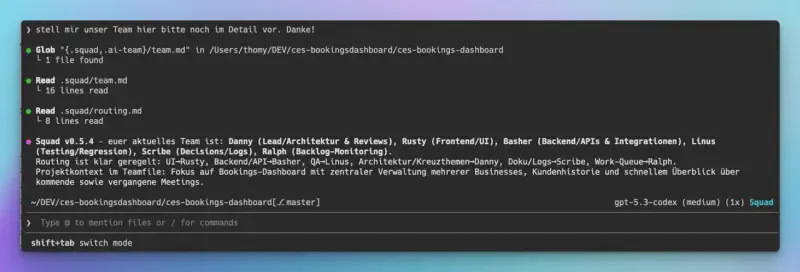
Every tool we talked about that day, Copilot, Claude Code or my own setup, is a harness around a model that remembers nothing, and the only real job left for us is putting good context into the context window. Good context doesn’t mean more context. If I give an agent three options that contradict each other, it has no way of knowing which one I meant, and no amount of model capability fixes a muddled brief. The bottleneck has moved from my hands to my head, and my head isn’t getting faster at the same rate as the models are.
My shortcut was twenty years of doing it by hand
Here’s what I find uncomfortable. When Bob builds that dashboard in two hours, it works because I know how to steer him, and I know how to steer him because I’ve been in SharePoint since 2007. I can see when he gets it wrong, often before he notices himself, and none of that came from reading. It came from doing it the slow way, breaking things and fixing them, with plenty of dirt under my fingernails.
That’s not an even playing field, and I said so in the room. The people who get the most out of these tools right now are the ones who learned the hard way before the tools existed, which means the advantage goes to exactly the people who needed it least. The judgement that makes cheap building useful was paid for with expensive building.
The next generation won’t get the dirt under their fingernails
Stephan and I both teach at a university back home, and in every single course someone asks me what they should learn now. It’s a tough question when a nineteen or twenty-year-old asks it in earnest. The honest answer is that I don’t fully know, because the path that made me useful doesn’t exist for them anymore. Nobody will make them build the dashboard by hand first, and why would anyone, when an agent does it during lunch?
What I do believe is that we have to build environments where young people still struggle on purpose. Not out of nostalgia, but because struggling with a problem is how you learn to think about it, and thinking is the one thing that just got more valuable. If everything comes pre-built and pre-answered, people stop questioning what comes back, and critical thinking is exactly the skill the cheap building depends on. We’re about to automate away the place where people learned the thing we now need most from them.
Cogito, ergo build, but who teaches the cogito?
Descartes doubted everything until only one thing was left that he couldn’t argue away, and in 2026 the building is no longer that thing. Anyone can build now, and that’s a good thing, I’m not nostalgic about writing boilerplate. What’s left is the thinking, and if we want people in five or ten years who can think clearly about what they build, somebody has to make sure they still get to do the slow, frustrating part first. I don’t have the full answer to that yet. I’m fairly sure, though, that “just ask the agent” isn’t it.
Enjoyed this post? Let's continue on LinkedIn.
Follow on LinkedIn